


Last updated: June 2026 | Read time: ~10 minutes
LASIK is legendary for its quick recovery and life-changing visual freedom. However, if you are researching laser vision correction in Santa Rosa, you have likely encountered discussions about its most common temporary side effect: post-LASIK dry eye.
For the modern North Bay professional, spending hours on screens, dealing with seasonal Sonoma County allergens, or commuting in air-conditioned vehicles can amplify eye sensitivity. Understanding why dry eye happens, how long it lasts, and how we proactively manage it at LaserVue Eye Center ensures a smooth, comfortable transition to clear vision.
LASIK is legendary for its quick recovery and life-changing visual freedom. However, if you are researching laser vision correction in Santa Rosa, you have likely encountered discussions about its most common temporary side effect: post-LASIK dry eye.
For the modern North Bay professional, spending hours on screens, dealing with seasonal Sonoma County allergens, or commuting in air-conditioned vehicles can amplify eye sensitivity. Understanding why dry eye happens and how long it lasts.
TL;DR
- Dry eye is a common, temporary side effect affecting 20% to 40% of patients in the first few months after LASIK.
- The primary cause is a temporary disruption of corneal nerves that regulate tear production during the creation of the LASIK flap.
- Most patients experience a significant reduction in dry eye symptoms within 3 to 6 months after the procedure.
- Pre-operative screenings at LaserVue use advanced diagnostic imaging to identify and treat baseline dry eye before surgery even begins.
- Modern post-op protocols include customized lubricating regimens, prescription drops, and local environmental adjustments to optimize healing.
Why Does LASIK Cause Temporary Dry Eye?
To understand post-LASIK dry eye, it helps to understand how your eyes produce tears. Your tear film is a complex ecosystem regulated by a feedback loop between your corneal nerves and your tear glands.
The Nerve-Tear Feedback Loop
During the LASIK procedure, a precise, micro-thin flap is created on the cornea’s surface to allow the laser to reshape the underlying tissue. This process temporarily alters some of the microscopic corneal nerves responsible for sensing dryness.
Because these nerves are temporarily resting, they don’t immediately signal the lacrimal glands to produce baseline tears. As a result:
- Your natural blink rate may temporarily decrease.
- The eye produces fewer lubricating tears in response to environmental triggers.
- The tear film evaporates more rapidly, leading to sensations of grittiness, stinging, or intermittent blurred vision.
As these microscopic nerves naturally regenerate over the months following your procedure, the feedback loop restores itself, and baseline tear production returns to normal.
The Role of Advanced Technology: Bladeless iLASIK
Technology plays a significant role in corneal healing. Older LASIK methods relied on a mechanical blade (a microkeratome) to create the corneal flap.
At LaserVue Eye Center, we utilize all-laser, bladeless iLASIK technology. By using a nano-ultra-fast femtosecond laser to create a highly customized, uniform, and architectural flap, we preserve more of the corneal nerve architecture. This advanced precision minimizes both the severity and duration of transient dry eye symptoms compared to outdated, blade-based techniques.
Understanding Your Recovery: The Dry Eye Timeline
For the vast majority of Santa Rosa patients, dry eye post-LASIK is a manageable, temporary phase of the healing process.
Month 1: Most patients experience their peak dry eye symptoms during the first month after LASIK. Common sensations include mild to moderate grittiness, occasional stinging, light sensitivity, and blurred vision, which often improve with frequent use of preservative-free eye drops. Symptoms are most noticeable in environments with air conditioning, wind, or prolonged screen use.
Month 3: At this stage, symptoms usually lessen, but about 20 to 40 percent of patients may notice mild, lingering dryness, sometimes felt as a scratchy or tired sensation at the end of the day, especially after long hours at work or when exposed to allergens.
Month 6: For most, corneal nerves have fully stabilized, and the tear film typically returns to baseline. Any dryness or discomfort that remains beyond this point is uncommon and generally much milder, often needing drops only occasionally or not at all.
Schedule your free LASIK consultation at LaserVue. Most exams are completed in under 60 minutes.What to Expect Week by Week
| Time Post-Op | Typical Symptoms | Management Strategy |
| Hours 0–24 | Burning, scratchiness, heavy tearing | Resting your eyes, keeping them closed, and using prescribed medicated drops. |
| Weeks 1–4 | Intermittent grittiness, dryness fluctuating with screen use, and temporary vision blur. | Preservative-free artificial tears every 1 to 2 hours; scheduled medicated drops. |
| Months 2–3 | Mild dryness, especially in air-conditioned spaces or after long computer sessions. | Using lubricating drops 4 to 6 times a day; taking regular screen breaks. |
| Months 6+ | Resolution of temporary symptoms: eyes feel natural, and baseline tear film is restored. | Occasional use of over-the-counter drops during extreme weather or heavy travel. |
Proactive Prevention: The Pre-Op Screening at LaserVue
The best way to treat post-LASIK dry eye is to look for it before surgery. Many individuals suffer from underlying, asymptomatic dry eye caused by chronic contact lens wear, screen fatigue, or environmental factors.
At LaserVue, we never fast-track a patient into surgery. A critical element of our comprehensive evaluation involves advanced dry eye diagnostic testing:
- Schirmer’s Testing: Measures the actual volume of tears your eyes produce.
- Tear Film Break-Up Time (TBUT): Evaluates the quality and stability of your tear film to see how quickly your tears evaporate.
- Meibomian Gland Imaging: Captures high-resolution images of the oil-producing glands in your eyelids to ensure your tears have the necessary lipid layer to prevent rapid evaporation.
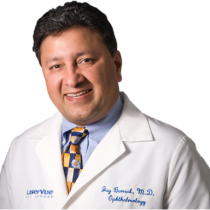
If severe, unmanageable chronic dry eye is detected, Dr. Bansal may recommend alternative vision correction procedures, such as SMILE or PRK, which preserve more of the superficial corneal architecture and carry a lower risk of worsening dry eye symptoms. Recovery after SMILE is typically even faster than after LASIK, with less disruption to corneal nerves and a lower risk of significant dry eye. PRK, while requiring a slightly longer surface-healing period than LASIK, also avoids creating a corneal flap and may be better tolerated by patients with existing dry eye. Exploring these options helps ensure you feel supported in finding the procedure that best fits your eye health and lifestyle.
How to Treat and Manage Post-LASIK Dry Eye
If you experience dry eye during your recovery, our clinical team provides a tiered, customized treatment plan tailored to your specific healing rate.
1. Clinical and Prescription Interventions
- Preservative-Free Artificial Tears: Standard over-the-counter drops contain preservatives that can irritate a healing cornea. We provide and recommend single-use, preservative-free vials to keep the eyes thoroughly lubricated throughout the day.
- Prescription Anti-Inflammatory Drops: Drops like Restasis, Xiidra, or temporary steroid drops may be utilized to reduce ocular surface inflammation and encourage your eyes to produce more of their own natural tears.
- Punctal Plugs: For patients needing extra moisture retention, we can insert tiny, biocompatible, temporary plugs into the tear ducts. This blocks tear drainage, keeping your natural and artificial tears on the eye surface longer.
2. At-Home and Environmental Adjustments
Living in Sonoma County means dealing with warm, dry summers and seasonal agricultural or wildfire smoke elements. You can protect your eyes at home with these easy adjustments:
- The 20-20-20 Rule: When working at your computer, look away every 20 minutes at an object 20 feet away for 20 seconds to prompt a healthy blink reflex.
- Targeted Hydration: Drink plenty of water and talk to our team about incorporating high-quality Omega-3 fatty acid supplements to improve the quality of your tears.
- Control Your Airflow: Avoid pointing car vents, air conditioners, or bedroom fans directly at your face. Utilize a desktop humidifier if you spend long hours in an office setting.
Schedule Your Consultation at Our Santa Rosa/Petaluma Clinic
Don’t let the fear of temporary dry eyes keep you from experiencing life without the hassle of frames and contact lenses. At LaserVue Eye Center, our combination of experienced clinical care, rigorous pre-op diagnostics, and advanced bladeless laser technology ensures your safety, comfort, and vision are optimized at every step. While persistent dry eye after LASIK is very rare, our team is dedicated to providing ongoing support and care for these uncommon cases, offering trusted expertise and personalized treatment to help every patient achieve their best possible vision.

Frequently Asked Questions
Will I have permanent dry eye after LASIK?
For the vast majority of patients, no. Permanent dry eye following LASIK is exceedingly rare. Symptoms are typically a temporary part of the structural nerve healing process and resolve within 3 to 6 months as the corneal nerve loop fully recovers.
Can I get LASIK if I already have dry eyes?
Yes, depending on the severity. Many people have mild dry eye caused simply by wearing contact lenses. During your free consultation, we will thoroughly evaluate your tear film. If minor dry eye is present, we will treat and stabilize it before your procedure. If it is severe, we may recommend alternatives such as SMILE or PRK.
How often will I need to use eye drops after the procedure?
During the first month, you can expect to use preservative-free artificial tears frequently—often every 1 to 2 hours, even if your eyes do not feel dry. This actively supports corneal healing. By months 2 and 3, most patients scale back to 4 times a day or only as needed.
Does the Santa Rosa climate affect post-LASIK recovery?
Sonoma County’s climate is beautiful, but hot summer days, morning coastal fog, and seasonal allergens can sometimes make dry eye symptoms more noticeable. Wearing UV-protected sunglasses outdoors and keeping lubricating drops handy during high-pollen or windy days easily mitigates this environmental friction.
See also: LASIK Myths in Santa Rosa: What’s True and What’s Not | What to Avoid After LASIK in Santa Rosa (And Why It Matters)
About LaserVue Eye Center
LaserVue Eye Center has been the Bay Area’s and Sonoma County’s trusted destination for LASIK, cataract surgery, and premium vision correction since 1996. Our board-certified ophthalmologists have performed thousands of procedures across our San Francisco and Santa Rosa locations, combining advanced surgical technology with the individualized care that brings patients back and earns referrals from their neighbors, colleagues, and physicians. Learn more about our cataract surgery program and meet our surgical team.