
Cataract Surgery in Santa Rosa
Cataract surgery in Santa Rosa, close to home in Sonoma County
If a cataract is clouding your vision, you can have your evaluation, lens-option review, and cataract surgery handled right here in Santa Rosa, without a drive over the bridge to the city. LaserVue Eye Center sits on Mendocino Avenue just north of downtown, off Highway 101, and serves candidates from across Sonoma County and the North Bay. Cataract surgery removes the eye’s clouded natural lens and replaces it with a clear artificial intraocular lens (IOL). It is one of the most commonly performed procedures in eye care, done as a same-day outpatient visit, usually one eye at a time.
LaserVue has cared for Bay Area vision since 1996, and the practice serves Santa Rosa and San Francisco from two offices, so your care does not end when surgery does. Board-certified surgeons examine your eyes, confirm whether a cataract is what is affecting your vision, and walk you through standard and premium lens options at a free consultation. Call (707) 522-6200 or book a free consultation with the Santa Rosa team.
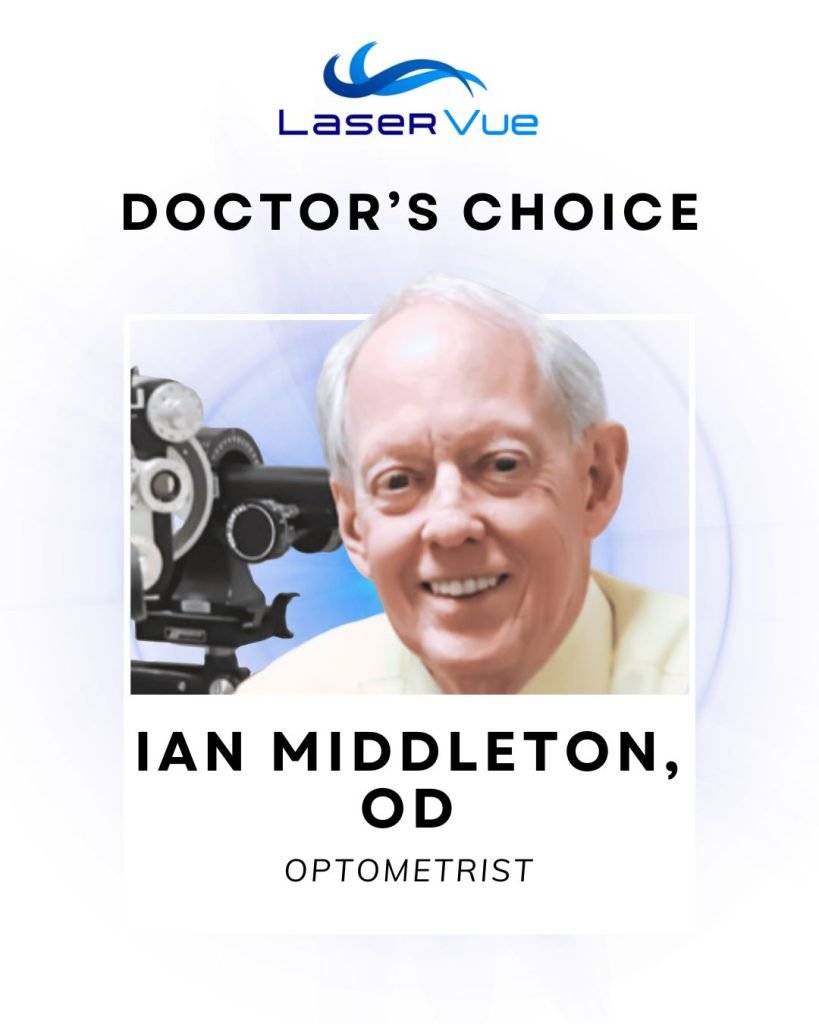
“LaserVue Eye Center are my first choice for LASIK and cataract surgery both for myself and for my patients. My patients appreciate the friendly and caring approach and the excellent care LaserVue provides. That is why I chose LaserVue for my own cataract surgery.”
— Dr. Ian Middleton, Optometrist
What is a cataract, and when is it time for surgery?
A cataract is a clouding of the eye’s natural lens. The lens sits behind the colored part of the eye and focuses light onto the retina. As proteins in the lens break down with age, the lens grows cloudy and yellowed, and vision becomes blurry, dim, or harder to use in low light. Cataracts usually develop slowly over years, most often after age 60, though eye injury, diabetes, long-term steroid use, and family history can bring them on earlier.
Common signs that a cataract is affecting your vision include:
- Blurry, cloudy, or filmy vision that glasses no longer fully correct
- Increasing glare and halos around headlights at night
- Colors that look faded or yellowed
- Needing brighter light to read
- Frequent changes to your glasses prescription
- Double vision in one eye
Surgery is generally considered when a cataract starts to interfere with daily life, such as driving Highway 101 at night, reading, or recognizing faces. There is no need to wait until a cataract is fully developed. A free consultation in Santa Rosa is the way to find out whether it is time, and a board-certified surgeon will confirm whether a cataract, and not another eye condition, is what is affecting your vision.
Why Sonoma County chooses LaserVue for cataract care
- Care in Santa Rosa, not a trip to the city. Your consultation and cataract care are handled at the Mendocino Avenue office, so most Sonoma County candidates skip the commute to San Francisco. The Van Ness Avenue office is available as a second option if it suits you better.
- Privately owned, not an assembly-line chain. LaserVue is a full vision-correction and ophthalmology practice, so your cataract evaluation is done by a team that treats the whole eye, with continuity of care across both Bay Area offices.
- Board-certified surgeons. Your procedure and lens selection are handled by board-certified surgeons who explain what to expect for your eyes.
- A full range of lens technology. From standard monofocal lenses to toric, extended-depth-of-focus, multifocal, and light-adjustable options, your surgeon matches the lens to how you want to see.
- Free parking and a short drive across the county. The office serves Rohnert Park, Cotati, Windsor, Petaluma, Healdsburg, Sebastopol, and Sonoma, with on-site parking on Mendocino Avenue.
- Free consultation and clear financing. A no-obligation consultation, with CareCredit and in-house financing for lens upgrades not covered by insurance.
Choose the lens that fits your life
| Lens option | What it does | Coverage |
|---|---|---|
| Standard monofocal lens | Restores clear vision at one distance, usually far. Glasses may still help for tasks such as reading. | Typically covered by Medicare and most insurance. |
| Toric lens | Corrects astigmatism to sharpen focus for candidates who have astigmatism. | Out-of-pocket upgrade. Financing available. |
| Multifocal or EDOF lens | Designed for a wider range of vision, which can reduce dependence on glasses for more activities. | Out-of-pocket upgrade. Financing available. |
| Light-adjustable lens | A premium lens that can be fine-tuned with light treatments after surgery toward your vision goals. | Out-of-pocket upgrade. Financing available. |
Standard versus laser-assisted cataract surgery
Cataract surgery can be performed with traditional manual instruments or with a femtosecond laser that assists with several steps of the procedure. Both approaches remove the clouded lens and replace it with an intraocular lens, and both are performed as a same-day outpatient procedure. Your surgeon will discuss which approach suits your eyes and your lens choice at your consultation.
- Traditional cataract surgery. The surgeon uses a small handheld instrument to create the opening and an ultrasound device to gently break up and remove the cataract. This is a long-established, widely performed technique.
- Laser-assisted cataract surgery. A femtosecond laser assists with creating the incisions, opening the lens capsule, and softening the cataract. It can also help reduce astigmatism at the time of surgery for the right candidate. Laser-assisted surgery is often paired with premium lenses and may involve an out-of-pocket cost.
There is no single right answer for everyone. A board-certified surgeon recommends the approach that fits your eyes, your lens goals, and your budget.
What to expect on the day of surgery
Cataract surgery is quick and well tolerated. The surgery itself usually takes about 15 to 30 minutes per eye, though you should plan to be at the surgery center for a few hours that day to allow for preparation and a short recovery before you head home.
- You stay awake, and your eye is numbed. The eye is numbed with drops or a gentle injection, and you may be given medication to help you relax. You will not see the details of the procedure.
- The cataract is removed and the new lens is placed. Through a tiny self-sealing incision, the surgeon removes the clouded lens and inserts your chosen intraocular lens. Stitches are usually not needed.
- You go home the same day. Because the procedure is outpatient and you may be sedated, arrange for someone to drive you home.
- One eye at a time. When both eyes have cataracts, surgery is typically scheduled for one eye first, with the second eye done a short time later once the first is healing well.
Recovery after cataract surgery
Most people notice clearer vision within a few days, and many resume light daily activities quickly. Full healing generally takes several weeks, and your Santa Rosa care team guides you through each step.
- The first day or two. Vision is often blurry at first, and the eye may feel scratchy or sensitive to light. This is normal and improves quickly for most people.
- Eye drops and follow-up. You will use prescription eye drops to prevent infection and control inflammation, and you will have follow-up visits so your surgeon can confirm the eye is healing as expected.
- Protect the eye. Avoid rubbing the eye, keep soap and water out of it, and wear the protective shield as directed, including while you sleep if your surgeon recommends it.
- Driving and activity. Many people return to desk work within a day or two, with more strenuous activity added back over the following week. Your surgeon tells you when it is safe to drive again based on how your eye is healing.
Recovery varies by person and by the lens you choose. Your surgeon gives you guidance specific to your eyes at every visit.
Is cataract surgery safe? Understanding risks and results
Cataract surgery is one of the most frequently performed and well-studied procedures in medicine, and most people see a meaningful improvement in their vision afterward. As with any surgery, there are risks, which your surgeon reviews with you so you can make an informed decision. They are uncommon but can include infection, inflammation, swelling, increased eye pressure, or retinal problems, and most are treatable when addressed promptly.
A common and easily treated event is posterior capsule opacification, sometimes called a secondary cataract. Months or years after surgery, the thin membrane behind the lens implant can become cloudy and blur vision again. It is not a cataract returning, and it is corrected in a few minutes with a painless in-office laser treatment called a YAG capsulotomy.
No surgeon can guarantee a specific outcome, and results vary by candidate. The best way to understand what cataract surgery can realistically do for your eyes is a free consultation, where a board-certified surgeon evaluates your vision and explains your options.
Cataract surgery cost and financing in Sonoma County
Standard cataract surgery is typically covered by Medicare and most insurance plans, because a cataract is a medical condition, so your out-of-pocket cost for the basic procedure is often low. If you choose a premium lens or laser-assisted surgery to reduce your dependence on glasses, that upgrade is an additional out-of-pocket cost.
The Santa Rosa team makes premium options manageable with CareCredit and in-house financing. At your free consultation we review your insurance and Medicare coverage, confirm your candidacy, and explain your lens choices, then give you a clear written estimate so there are no surprises.
What to expect, step by step
- Free consultation in Santa Rosa. A board-certified surgeon examines your eyes and confirms whether cataract surgery is right for you.
- Choose your lens and surgical approach. We explain standard and premium lens options, traditional versus laser-assisted surgery, and give you a written cost and financing estimate based on your insurance.
- Surgery day. Cataract surgery is a same-day outpatient procedure, usually one eye at a time, with the eye numbed and the visit lasting a few hours.
- Recovery and follow-up. You use prescription drops, attend follow-up visits, and your Santa Rosa care team guides you through healing, including when it is safe to resume driving.
Cataract care for the whole North Bay
The Santa Rosa office is a short drive for candidates across Sonoma County and the North Bay. We regularly care for people from Rohnert Park, Cotati, Windsor, Petaluma, Healdsburg, Sebastopol, and Sonoma, and across greater Sonoma County. If you have been told you have a cataract, or you suspect one because night driving and reading have become harder, you can have the entire process handled locally on Mendocino Avenue rather than commuting to the city.
Prefer San Francisco? The same practice and the same standard of care are available at the Van Ness Avenue office, so you can choose the location that fits your life.
Visit the LaserVue Santa Rosa office
LaserVue Eye Center is on Mendocino Avenue in Santa Rosa, serving Sonoma County and the North Bay, including Rohnert Park, Cotati, Windsor, Petaluma, Healdsburg, Sebastopol, and Sonoma. Free parking on site and a short drive from across the county.
- LaserVue Eye Center, Santa Rosa
- 3540 Mendocino Ave, Suite 200, Santa Rosa, CA 95403
- Phone: (707) 522-6200
Prefer the city? The LaserVue San Francisco office is at 711 Van Ness Ave, Suite 320, San Francisco, CA 94102, (415) 346-5500.
Ready to see clearly again? Book a free cataract consultation with the Santa Rosa team. No obligation, and financing is available.
Frequently Asked Questions
Where is LaserVue’s cataract surgery office in Santa Rosa?
LaserVue Eye Center is at 3540 Mendocino Avenue, Suite 200, Santa Rosa, CA 95403, just north of downtown off Highway 101. Call (707) 522-6200 to book a free cataract consultation with the Santa Rosa team.
Do I have to travel to San Francisco for cataract surgery, or can it be done in Santa Rosa?
Your consultation and care can be handled at the Santa Rosa office on Mendocino Avenue, so most Sonoma County candidates do not need to drive over the bridge to the city. LaserVue also has a San Francisco office on Van Ness Avenue if that location is more convenient for you. Your surgeon confirms the plan at your free consultation.
Which Sonoma County and North Bay towns does LaserVue Santa Rosa serve for cataract surgery?
The Santa Rosa office serves candidates from across Sonoma County and the North Bay, including Rohnert Park, Cotati, Windsor, Petaluma, Healdsburg, Sebastopol, and Sonoma. The office on Mendocino Avenue has free parking and is a short drive from most of the county.
What are the signs that I might need cataract surgery?
Common signs include blurry or cloudy vision that glasses no longer fully correct, glare and halos around lights at night, colors that look faded, needing brighter light to read, and frequent changes to your prescription. Surgery is generally considered when a cataract interferes with daily activities. A free consultation in Santa Rosa confirms whether a cataract is what is affecting your vision.
Is cataract surgery covered by insurance or Medicare?
Standard cataract surgery is typically covered by Medicare and most insurance plans because a cataract is a medical condition. Premium lens upgrades and laser-assisted surgery are usually an out-of-pocket cost. The Santa Rosa team reviews your specific coverage and provides a written estimate at your free consultation.
What is the difference between standard and laser-assisted cataract surgery?
Both remove the clouded lens and replace it with an intraocular lens as a same-day outpatient procedure. Traditional surgery uses handheld instruments and ultrasound, while laser-assisted surgery uses a femtosecond laser to assist with several steps and can help address astigmatism for the right candidate. Laser-assisted surgery is often paired with premium lenses and may involve an out-of-pocket cost. Your surgeon recommends the approach that fits your eyes and goals.
How long does cataract surgery take and will I be awake?
The surgery itself usually takes about 15 to 30 minutes per eye, though you should plan to be at the surgery center for a few hours that day. You stay awake, your eye is numbed with drops or a gentle injection, and you may receive medication to help you relax. Arrange for someone to drive you home afterward.
Will I still need glasses after cataract surgery?
It depends on the lens you choose. A standard monofocal lens corrects one distance, so glasses may still help for some tasks such as reading. Premium lenses are designed to reduce your dependence on glasses for more activities. Results vary by candidate, and your surgeon helps you choose during your consultation.
How long is recovery after cataract surgery?
Cataract surgery is a same-day outpatient procedure, usually performed one eye at a time. Most people notice clearer vision within a few days and resume light activities quickly, while full healing generally takes several weeks. You use prescription eye drops and attend follow-up visits. Your Santa Rosa surgeon gives you specific recovery and driving guidance based on your eyes.
Can both eyes have cataract surgery at the same time?
When both eyes have cataracts, surgery is typically scheduled for one eye first, with the second eye done a short time later once the first is healing well. Your surgeon explains the timing that is right for your eyes at your consultation.
Can a cataract come back after surgery?
A cataract itself does not return, because the clouded lens is removed. Some people develop posterior capsule opacification, sometimes called a secondary cataract, when the membrane behind the lens implant becomes cloudy months or years later. It is corrected in a few minutes with a painless in-office laser treatment called a YAG capsulotomy.
Is cataract surgery safe?
Cataract surgery is one of the most frequently performed and well-studied procedures in medicine, and most people see a meaningful improvement in their vision. As with any surgery there are risks, which are uncommon and which your surgeon reviews with you so you can make an informed decision. No surgeon can guarantee a specific outcome, and results vary by candidate.
What does cataract surgery cost in Santa Rosa?
Standard cataract surgery is typically covered by Medicare and most insurance, so out-of-pocket cost for the basic procedure is often low. Premium lenses and laser-assisted surgery are an additional out-of-pocket cost that varies by the options you choose. The Santa Rosa team reviews your coverage and provides a clear written estimate at your free consultation, with CareCredit and in-house financing available.
Ready to SEE a Change?
Helping you to achieve your personal best vision is our mission at LaserVue Eye Center. Wondering where to start?
Please complete the fields on the right to schedule a free consultation and discuss your options with our eye doctors! You can also Call 1-800-527-3745 to speak with our staff.
