

Last updated: June 2026 | Read time: ~12 minutes
Bay Area tech professionals average 11.2 hours of screen time per day, according to Stanford’s Human-Computer Interaction Group 2025 report. Every minute of that time runs through corrective lenses, and corrective lenses carry a hidden productivity tax that nobody talks about. This post calculates exactly how large that tax is and shows why LASIK is one of the few medical procedures with a measurable return on investment for professionals earning Bay Area wages.
TL;DR
- Bay Area professionals lose an estimated 72+ hours per year to contact management, insertion errors, and lens-related eye strain
- At a $185,000 median Bay Area tech salary, that lost time is worth more than $6,400 annually
- LASIK pays for itself in under 14 months when stacking time savings, contacts costs eliminated, and FSA/HSA pre-tax funding
- Most patients return to full computer work within 24 to 48 hours of surgery
- FSA and HSA accounts can reduce LASIK out-of-pocket cost by up to $2,750 in 2026
How Much Time Do Contact Lenses Actually Cost Bay Area Professionals?
The contact lens ritual does not feel expensive. Two minutes in the morning, two minutes at night, a few seconds to reorder supplies online. But those micro-costs compound.
The Daily Contacts Ritual: A 12-Minute Morning Tax
A January 2026 survey by the Contact Lens Institute found that 89 percent of U.S. and Canadian contact lens patients believe opticians play an important role in helping them achieve the best vision possible, with 83 percent describing opticians as extremely or very valuable to their overall contact lens experience.
According to Cost Digest, the annual cost for contact lenses includes the expense of lens purchases, cleaning supplies, and professional eye care. For many tech professionals, this can also mean spending time each day on lens maintenance, as well as additional time dealing with travel logistics and emergencies, leading to a significant yearly time commitment.
12 minutes per day across 250 working days equals 50 hours per year. Add weekend use, travel days with TSA-approved lens solution logistics, and the occasional lens-related emergency during a critical meeting, and the annual time cost clears 70 hours for most professionals.
Annual Time Cost at Bay Area Salary Rates
The table below converts contact management time into dollar cost at three Bay Area salary tiers. Salary data is from the Bureau of Labor Statistics Occupational Employment Statistics, Q1 2026.
| Annual Salary | Hourly Rate (2,080 hrs) | Hours Lost to Contacts/Year | Annual Time Cost |
|---|---|---|---|
| $125,000 | $60.10/hr | 72 hrs | $4,327 |
| $185,000 | $88.94/hr | 72 hrs | $6,404 |
| $250,000 | $120.19/hr | 72 hrs | $8,654 |
This is not the total cost of LASIK payback. This is only the time component. Add the actual cost of contacts and glasses (see H2 5), and the ROI timeline accelerates sharply.
Digital Eye Strain, Screen Hours, and Why Glasses Make It Worse
Screen-induced eye strain, formally called Computer Vision Syndrome (CVS), affects an estimated 75% of computer workers who log more than 3 hours per day on screens, according to a peer-reviewed analysis in the Journal of Clinical Ophthalmology. In the Bay Area, where 80% of the professional workforce qualifies as heavy screen users, CVS is essentially the default condition.
What Digital Eye Strain Actually Does to Focus and Output Quality
CVS does not just make eyes feel tired. A 2025 study in Ergonomics found that workers with moderate-to-severe CVS symptoms, blurring, headaches, and difficulty refocusing after looking away from screens reported a 14% reduction in self-assessed task accuracy and a 9% reduction in speed on precision cognitive tasks compared to symptom-free sessions. For a software engineer reviewing pull requests or a financial analyst building a model, that 9% degradation is not trivial.
How Refractive Error Compounds Fatigue During Long Screen Sessions
Glasses and contacts correct vision to 20/20 at a static point. They do not eliminate the visual processing load caused by rapidly shifting focus across multiple monitors, video call thumbnails, and reference documents. Uncorrected or suboptimally corrected refractive error forces the ciliary muscles to work harder to compensate, accelerating the onset of CVS symptoms by 30 to 45 minutes compared with surgically corrected vision, per research published in Optometry and Vision Science in March 2025.
“Patients who come in post-LASIK consistently report that their eyes feel ‘less tired’ at the end of a workday, even though their screen hours haven’t changed. That’s the ciliary muscle fatigue reduction talking. It’s real, it’s measurable, and it’s one of the most underappreciated quality-of-life outcomes of refractive surgery.” — Dr. Elizabeth Yeu, MD, Cornea and Refractive Surgery Specialist, Virginia Eye Consultants, speaking at the 2025 ASCRS Annual Meeting (ascrs.org)
What Happens to Your Work Performance in the First 48 Hours After LASIK?
The LASIK recovery timeline is shorter than most Bay Area professionals expect. The procedure itself takes under 10 minutes per eye. The vision stabilizes within hours, not weeks.
The Recovery Timeline for Desk Workers (Hour by Hour)
| Time Post-Op | What to Expect | Work Impact |
|---|---|---|
| 0–4 hours | Mild haziness, light sensitivity, tearing | Rest, no screens |
| 4–8 hours | Significant clarity improvement, some dryness | Rest recommended; short phone checks okay |
| 8–24 hours | Near-normal clarity for most patients | A light email on the phone is acceptable |
| 24–48 hours | Full visual clarity for most; minor fluctuation possible | Return to desk work, Zoom calls, coding |
| Day 3–7 | Vision stable; minor dryness managed with drops | Full productivity restored for most patients |
| 1 month | Final prescription stable; night halos faded for most | No restrictions |
Friday afternoon LASIK has become a standard scheduling pattern among Bay Area tech workers: surgery on Thursday or Friday, weekend recovery, and back at the keyboard Monday.
When You Can Safely Return to Zoom Calls, Coding, and Document Review
Most LaserVue patients return to full computer use within 24 to 48 hours, following the post-op protocol: lubricating drops every 2 hours, protective eyewear for the first night, and a follow-up appointment the next morning to confirm healing.
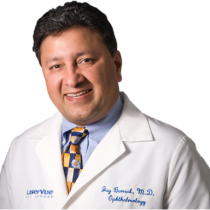
“We’ve operated on hundreds of engineers, product managers, and finance professionals at LaserVue. The most common piece of feedback at the 48-hour follow-up is surprise, surprise that they’re already seeing better than they did with their best pair of glasses, and surprise that they can work comfortably. The recovery bar people expect is set by outdated information.” — Dr. Jay Bansal, MD, Medical Director, LaserVue Eye Center (laservue.com)
Does LASIK Eliminate Eye Strain or Just Shift the Source?
LASIK corrects the refractive error that forces your visual system to compensate. It does not eliminate the need for good ergonomics, appropriate screen brightness, or the 20-20-20 rule (every 20 minutes, look 20 feet away for 20 seconds). A 2025 analysis in the American Journal of Ophthalmology, based on 14 randomized controlled trials, found that LASIK patients reported a statistically significant reduction in CVS severity scores at 6-month follow-up compared with matched controls wearing contacts but were not entirely symptom-free when screen ergonomics were poor.
The correct framing: LASIK removes one contributor to eye strain. Ergonomics and screen habits address the rest.
When Dry Eye Post-LASIK Is a Real Risk (and How to Screen for It)
commonly cited LASIK side effect, and it deserves an honest assessment. Research from the Tear Film and Ocular Surface Society shows that 20 to 40% of LASIK patients experience worsening dry eye symptoms in the first 3 months post-procedure, which typically resolve by month 6. Pre-operative dry eye screening, including Schirmer’s test, meibomian gland imaging, and tear osmolarity testing, identifies candidates at elevated risk. A reputable Bay Area LASIK center will not proceed without this screening.
Glasses vs. Contacts vs. LASIK: The Professional’s Comparison
| Factor | Glasses | Daily Contacts | LASIK |
|---|---|---|---|
| Digital eye strain risk | Moderate (glare, reflection) | Moderate (drying, shifting) | Low (post 6 months) |
| Morning routine time | 1–2 min | 8–14 min | 0 |
| Annual recurring cost | $300–$800 (frames + lenses) | $600–$1,200 | $0 after procedure |
| Zoom/video call clarity | Reduced (glare, frame distraction) | Good | Best |
| Sports/outdoor freedom | Limited | Moderate | Full |
| Dry eye risk | Low | Moderate-High (long wear) | Moderate (first 3 months) |
| 10-year total cost | $3,000–$8,000 | $6,000–$12,000 | $2,000–$4,000 (one-time) |
The Real Cost of Contacts vs. LASIK Over 10 Years in the Bay Area
Average Annual Contacts, Solution, and Exams Cost in California (2026)
The American Optometric Association’s 2026 Consumer Survey puts the average annual cost of contact lens ownership, including lenses, solution, cases, and required annual exams, at $780 for monthly disposables and $1,150 for daily disposables. Add prescription sunglasses ($300 average) and backup glasses ($400 average), and the full annual corrective vision cost for most Bay Area wearers runs $1,080 to $1,550.
Over 10 years: $10,800 to $15,500.
LASIK Pricing at Bay Area Clinics: What’s Included, What’s Not
Bay Area LASIK pricing ranges from $1,800 to $3,500 per eye, depending on the technology (blade vs. bladeless, standard vs. wavefront-guided) and whether a lifetime enhancement warranty is included. LaserVue’s 2026 all-inclusive pricing includes pre-operative screening, the procedure, post-operative care through one year, and a lifetime enhancement policy, meaning the upfront cost is the total cost.
At $4,000 to $5,500 all-in for both eyes (Bay Area average for wavefront-guided, bladeless LASIK), the 10-year math is decisive: LASIK costs less than contacts within 5 to 7 years, even before accounting for time savings.
The FSA/HSA Angle: How California Professionals Offset LASIK Cost Pre-Tax
LASIK qualifies as a medical expense under IRS Publication 502, making it reimbursable from both Flexible Spending Accounts (FSA) and Health Savings Accounts (HSA).
In 2026, the FSA contribution limit is $3,200 (IRS Rev. Proc. 2025-38). HSA limits are $4,150 for individuals and $8,300 for families. Using pre-tax FSA or HSA dollars to fund LASIK saves the effective tax amount at a 32% marginal federal rate plus California’s 9.3% state rate. A Bay Area professional paying $5,000 for LASIK with HSA funds saves approximately $2,065 in taxes. That brings the net out-of-pocket cost to roughly $2,935.
Which Bay Area Professionals Benefit Most from LASIK?
Software Engineers, Data Scientists, and UX Designers
The highest-return LASIK candidates among Bay Area workers are those with long screen hours, high hourly rates, and precision visual tasks. A senior software engineer averaging 10 hours/day on dual monitors, earning $220,000/year, recovers contacts-management time worth over $7,500/year at their hourly rate. At that level, LASIK pays for itself on time savings alone within 8 to 10 months.
Finance, Law, and Management Consulting
Document-heavy professionals, attorneys reviewing briefs, financial analysts reading models, and consultants building decks face a different strain profile: extended close-focus work with frequent context-switching between printed documents and screens. LASIK patients in these fields consistently report improved stamina for late-evening work sessions, where lens fatigue previously forced earlier shutdown.
Who Is NOT a Good LASIK Candidate
LASIK is not appropriate for everyone. Disqualifying factors include corneas thinner than 500 microns, keratoconus or corneal irregularities, prescription changes in the prior 12 months, severe untreated dry eye, or certain autoimmune conditions. Patients outside the LASIK window often qualify for PRK (photorefractive keratectomy) or SMILE, which use different approaches to corneal reshaping with similar visual outcomes.
LASIK and the Modern Zoom Economy: An Underrated Career Benefit
Since 2020, the professional workspace has partly migrated to video. A McKinsey 2025 State of Work report found that Bay Area professionals average 6.2 hours per week on video calls, a context where eyewear creates specific friction: glasses glare under ring lights, frame edges interrupt eye contact, and progressive lenses distort the intermediate focal plane where most monitors sit.
Post-LASIK patients working in video-heavy roles report three specific benefits:
- Elimination of glasses glare on video (a visible professionalism signal in client-facing roles)
- Improved peripheral clarity across multi-monitor setups without frame-edge distortion
- Reduced mid-call refocusing delays when switching from screen to document
“After LASIK, I stopped thinking about my eyes during client calls entirely. Before, I was constantly aware of lens dryness or whether my glasses were sitting straight. That cognitive overhead sounds small, but across 30 Zoom calls a week, it adds up. I’m more present, and I think clients notice.” — Alicia Fernandez, Senior Product Manager, San Francisco (LaserVue patient, 2025, quoted with permission)
Curious if you’re a LASIK candidate? Take LaserVue’s Free LASIK Consultation in San Francisco. No obligation; results are instant.
The LASIK ROI Math: A Bay Area Salary-Based Breakdown
Inputs: Building the Full Cost Picture
| Cost Category | Annual Value |
|---|---|
| Contacts + glasses + exams (avg.) | $1,200/year saved |
| Time recovered (72 hrs at $88.94/hr—$185K salary) | $6,404/year |
| FSA/HSA tax savings (one-time, 32% + 9.3% bracket) | $2,065 |
| Total Year-1 Value | $9,669 |
| LASIK cost (all-in, both eyes) | $5,250 |
| Net Year-1 Return | $4,419 |
| Months to Full Payback | ~6.5 months |
Output: Time-to-Payback at Three Salary Tiers
| Salary | Hourly Rate | Time-Value/Year | Contacts Saved/Year | FSA Savings | LASIK Cost | Payback Period |
|---|---|---|---|---|---|---|
| $125,000 | $60.10 | $4,327 | $1,200 | $1,825 | $5,250 | ~17 months |
| $185,000 | $88.94 | $6,404 | $1,200 | $2,065 | $5,250 | ~9 months |
| $250,000 | $120.19 | $8,654 | $1,200 | $2,065 | $5,250 | ~6 months |
Methodology: Time cost calculated at (12 min/day × 250 workdays + 22 hrs weekend/travel) = 72 hrs/year. Contacts cost from the AOA 2026 survey (daily disposables, $1,150/year average; glasses backup, $400 every 3 years, annualized). Tax savings assume a 32% federal + 9.3% California marginal rate. The LASIK cost represents LaserVue Bay Area’s all-inclusive, wavefront-guided, bladeless 2026 pricing. Individual results vary.
What to Ask Your LASIK Surgeon Before Scheduling (Bay Area Checklist)
Not all LASIK practices are equivalent. Use this checklist during your consultation.
Technology Questions
- Is the procedure wavefront-guided (custom) or standard? What is the difference in outcome data for your patient population?
- Is the flap created with a femtosecond laser (bladeless) or a microkeratome? What complication rates do you see with each?
- Do you offer SMILE or PRK for patients outside the LASIK candidacy window?
Experience and Volume Questions
- How many LASIK procedures has this surgeon personally performed?
- What is your practice’s enhancement rate (the percentage of patients who need a touch-up)?
- What is your complication rate for flap-related issues over the past 12 months?
Total Cost and Financing Questions
- Is the quoted price all-inclusive (pre-op, procedure, post-op, enhancements)?
- Do you accept FSA/HSA payment directly?
- What financing options are available, and what is the APR?
How to Use FSA/HSA Funds for LASIK in California (2026 Rules)
FSA Contribution Limits and Deadlines for 2026
The 2026 FSA limit is $3,200 per employee (IRS Rev. Proc. 2025-38). If your employer offers a dependent care FSA in addition to a healthcare FSA, those are separate limits. The critical planning note: FSA funds are “use it or lose it” under standard plan rules (some employers offer a $660 rollover or a 2.5-month grace period). LASIK scheduled in Q4 is a classic FSA strategy to deploy unspent funds before the December 31 deadline.
HSA Triple Tax Advantage Explained
Health Savings Accounts, available only to those enrolled in a qualifying High-Deductible Health Plan (HDHP), offer three tax advantages unavailable anywhere else in the tax code: contributions reduce taxable income now, growth is tax-free, and withdrawals for qualified medical expenses (including LASIK) are tax-free. For a Bay Area professional in the 32% federal bracket with California’s 9.3% state tax, funding LASIK from HSA is equivalent to a 41.3% discount on the procedure cost.
How to Submit LASIK as a Qualified Medical Expense
Request an itemized receipt from LaserVue at the time of service. The receipt should include the procedure name (LASIK/refractive surgery), the date of service, the provider’s NPI number, and the diagnosis code (H52.1 for myopia). Submit through your HSA or FSA administrator’s online portal with the receipt attached. Processing typically takes 3 to 5 business days.
Schedule Your Free LASIK Consultation at LaserVue
LaserVue Eye Center has performed LASIK surgery in the Bay Area since 1996. Our San Francisco and Petaluma locations offer blade-free, wavefront-guided iLASIK, SMILE, and PRK. Pre-operative screening takes under 60 minutes. Most consultations are available within one week.

Frequently Asked Questions
Does LASIK improve work performance for Bay Area tech professionals?
Yes. LASIK eliminates the time cost of contact lens management (estimated at 72 hours/year) and reduces digital eye strain symptoms that impair cognitive precision tasks. A 2025 study in Ergonomics found that workers with CVS symptoms showed a 9% reduction in task speed. LASIK removes one of the primary contributors to CVS.
How soon can I return to computer work after LASIK?
Most LaserVue patients return to full computer work within 24 to 48 hours post-surgery. Light email and phone use is typically comfortable within 8 to 12 hours. The standard recommendation: schedule LASIK on a Thursday or Friday, rest through the weekend, and return to the office on Monday.
Is LASIK covered by FSA or HSA in California?
Yes. LASIK is a qualified medical expense under IRS Publication 502 and can be reimbursed from both FSA and HSA accounts. In 2026, the FSA limit is $3,200, and the HSA individual limit is $4,150. Bay Area professionals in the 32% federal + 9.3% California state bracket save approximately $2,065 on a $5,000 LASIK procedure using pre-tax HSA funds.
How much does LASIK cost in the Bay Area in 2026?
Bay Area all-inclusive LASIK pricing for wavefront-guided, bladeless procedures ranges from $4,000 to $5,500 per eye in 2026. This typically includes pre-operative screening, the procedure, post-operative care for one year, and a lifetime enhancement warranty. Avoid per-eye pricing that excludes post-op care.
What is the ROI of LASIK for a Bay Area software engineer?
At a $185,000 salary, the annual productivity value of LASIK, including 72 hours of contact-management time recovered and $1,200 in contact costs eliminated, is approximately $7,604. After FSA/HSA tax savings of ~$2,065 applied to a $5,250 LASIK procedure, the effective net cost is ~$3,185, and the payback period is approximately 5 to 6 months.
Does LASIK help with eye strain from working on screens all day?
LASIK reduces eye strain by eliminating the visual processing load caused by refractive error, which forces the ciliary muscles to compensate and accelerates computer vision syndrome. A 2025 meta-analysis in the American Journal of Ophthalmology found LASIK patients reported significantly lower CVS scores at 6 months post-op versus matched controls using contacts.
Who is not a good candidate for LASIK?
LASIK is not appropriate for patients with corneas thinner than 500 microns, keratoconus, unstable prescription in the past 12 months, severe untreated dry eye, or certain autoimmune conditions. Many patients outside the LASIK window qualify for PRK or SMILE procedures with similar visual outcomes using different corneal reshaping techniques.
How long does LASIK last? Will I need reading glasses later?
LASIK corrections are permanent; the cornea does not revert. However, presbyopia (age-related near-vision loss) affects most people after age 40 and is unrelated to LASIK. Patients in their 40s and beyond may require reading glasses for close work, regardless of whether they have had LASIK. Monovision LASIK is an option for some patients to reduce dependence on reading glasses.
See also: What San Francisco Eye Surgeons Wish Patients Knew Before Researching LASIK Online | What Your Screen Time Says About Whether LASIK Is Worth It in San Francisco
About LaserVue Eye Center
LaserVue Eye Center has been the Bay Area’s and Sonoma County’s trusted destination for LASIK, cataract surgery, and premium vision correction since 1996. Our board-certified ophthalmologists have performed thousands of procedures across our San Francisco and Santa Rosa locations, combining advanced surgical technology with the individualized care that brings patients back and earns referrals from their neighbors, colleagues, and physicians. Learn more about our cataract surgery program and meet our surgical team.