

In Santa Rosa, where the nearest high-volume LASIK centers are often a drive away, that misinformation problem is compounded by fewer chances for casual word-of-mouth correction. Patients arrive at consultations having read the wrong things and having made up their minds. This post takes the most persistent LASIK myths circulating online right now, puts them to the test against clinical evidence, and tells you which are true, which are false.
TL;DR — The short version:
- Most myths about LASIK risk come from real but rare outcomes, stripped of statistical context.
- Thin corneas, dry eyes, and high prescriptions are not automatic disqualifiers — they require clinical evaluation.
- The cost gap between providers in and around Santa Rosa reflects real differences in technology and outcomes.
- Most Santa Rosa residents who self-screen out of LASIK online would qualify after a proper exam.
Myth #1: “LASIK Permanently Weakens Your Eyes”
Verdict: Misleading
This one traces back to early concerns about corneal biomechanics from the late 1990s, when laser profiles were less refined and candidacy screening was less rigorous. The claim has persisted online long past its clinical relevance.
What LASIK does: the laser reshapes the corneal stroma by removing a precise amount of tissue. The cornea does not regenerate that tissue. However, the cornea heals around the treated zone, and biomechanical integrity is maintained when candidacy screening is done properly.
The key phrase there is “when candidacy screening is done properly.” Pre-existing corneal thinning disorders, most notably keratoconus, are genuine contraindications, and modern topographic screening catches them reliably. A properly screened LASIK candidate does not have a weakened cornea after surgery. The myth conflates the risks of operating on an already-compromised cornea with those of operating on a healthy one.
What Corneal Biomechanical Screening Actually Looks Like
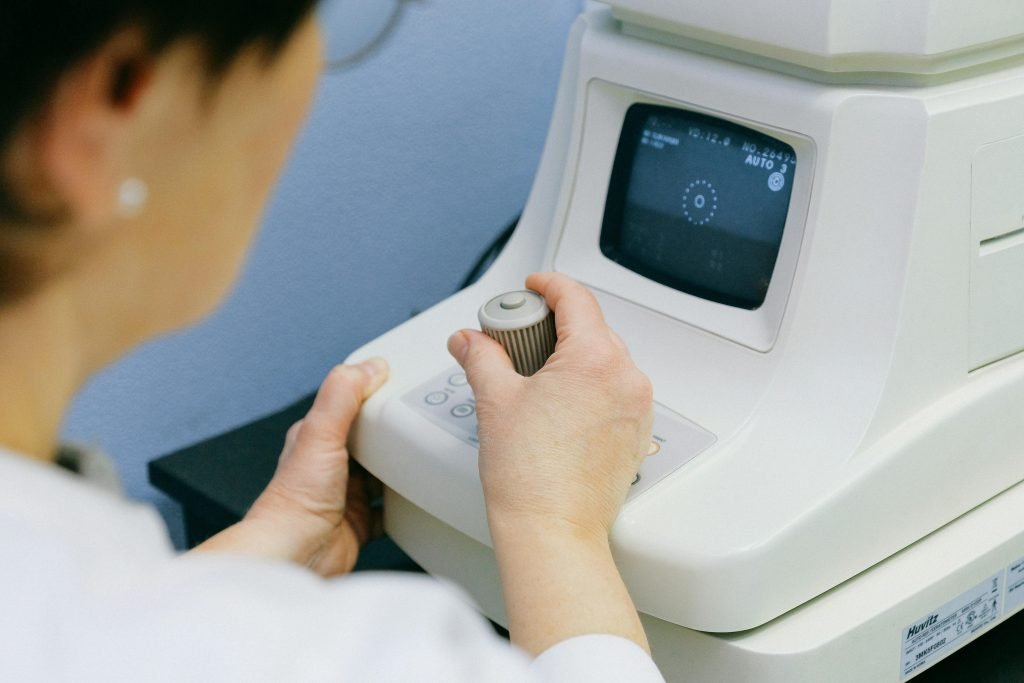
Modern pre-operative exams use Scheimpflug imaging (Pentacam) and corneal topography to produce a detailed 3D map of the corneal structure. These tools identify subtle irregularities that older technology missed. A patient cleared by Pentacam topography does not carry the same risk profile as a 1998 LASIK patient screened by keratometry alone.
Myth #2: “LASIK Results Only Last 10 Years”
Verdict: Partially True, With an Important Distinction
This is the most commonly misunderstood myth because it contains a kernel of truth mixed with a clinical error. The laser correction applied during LASIK is permanent. The corneal tissue that was removed does not return. A correction achieved on the day of surgery is still structurally present 20 years later.
What changes is not the LASIK correction. What changes is the natural lens of the eye.
Presbyopia is the age-related hardening of the crystalline lens that makes close-up focus difficult. It affects every adult, starting around age 40 to 45, with or without LASIK, glasses, or any other eye procedure. When a 52-year-old LASIK patient reaches for reading glasses, that is not LASIK wearing off. That is the same biological process happening to their non-LASIK friends.
A small percentage of patients, primarily those with very high initial prescriptions, experience mild myopic regression over the years. This is manageable. Enhancement procedures address it, and most patients with moderate prescriptions do not experience clinically significant regression, according to outcomes data from the ASCRS 2024 Clinical Survey.
“The confusion between presbyopia and LASIK regression is one of the most common and most consequential misunderstandings in refractive surgery patient education. They are completely separate biological events.” — American Academy of Ophthalmology, LASIK Patient Guide, 2024
Myth #3: “Everyone Gets Halos and Glare After LASIK”
Verdict: Partially True; Depends on Technology and Screening
Transient halos and glare are common in the first weeks after LASIK. This is a normal part of the healing process, not a permanent outcome. The cornea is recovering; optical imperfections during that window are expected and will resolve.
Persistent, quality-of-life-affecting halos and glare occur in fewer than 3% of patients treated with current-generation wavefront-guided laser platforms, according to ASCRS 2024 outcome data. The association between large pupils and post-LASIK halos was a real concern in the early 2000s, when treatment zones were smaller. Modern wavefront-guided treatments use larger optical zones that cover the pupil in low-light conditions, thereby substantially reducing this risk.
When This Myth Has More Basis
The 3% figure applies to screened patients at quality centers using current technology. Discount LASIK providers using older laser platforms, smaller treatment zones, or abbreviated candidacy screening produce worse outcomes. The myth is not true across all contexts. It is false for patients who carefully choose their provider.
Myth #4: “If You Have Dry Eyes, You Can’t Get LASIK”
Verdict: Misleading
This is the myth that sends the most Santa Rosa patients home convinced they’re permanently disqualified when they are not.
Dry eye is a spectrum. Mild-to-moderate dry eye that responds to treatment is not a LASIK contraindication. Severe, treatment-refractory dry eye, the kind that does not respond to punctal plugs, prescription cyclosporine drops, or meibomian gland expression, is a genuine contraindication. The clinical question is not “Do you have dry eye?” but “How severe is it, and does it respond to treatment? ”
Standard practice at competent LASIK centers includes a preoperative dry-eye workup using osmolarity testing (TearLab), meibography, LipiView interferometry, and Schirmer’s testing. If mild-to-moderate dry eye is found, a 4–8 week treatment protocol typically brings the tear film to a level suitable for safe LASIK. The treatment phase is not a barrier; it is preparation.
SMILE as a Lower-Dry-Eye Alternative
For patients with borderline dry eye who are concerned about post-operative symptoms, SMILE (Small Incision Lenticule Extraction) is an evidence-backed alternative. SMILE severs fewer corneal nerves than LASIK because it uses a smaller incision, resulting in lower rates of dry eye symptoms post-operatively. It is not the right procedure for everyone, but it is a viable option for patients with dry eye as a legitimate concern.
Myth #5: “Thin Corneas Mean You’re Not a LASIK Candidate”
Verdict: Misleading
Online LASIK calculators ask for the prescription and age. They do not measure corneal thickness. When they report that someone “may not qualify,” they are using a conservative population-level rule rather than a clinical measurement of that person’s corneas.
LASIK does require a minimum residual corneal thickness after the flap and treatment are applied, typically at or above 250 microns of residual stromal bed, per FDA guidance. Some corneas do not meet this threshold. But patients whose corneas are too thin for LASIK are frequently excellent candidates for PRK or SMILE, which accomplish the same correction without creating a flap or requiring the same tissue depth.
Thin corneas are a redirect, not a dead end. An online quiz cannot measure your corneal thickness. Only a topography exam can.
Myth #6: “LASIK Is Riskier Than Wearing Contacts Long-Term”
Verdict: False When Viewed Over the Full Risk Period
This comparison is almost never made in online LASIK discussions, which tend to present LASIK risk in isolation. The relevant comparison is not LASIK vs. nothing; it is LASIK vs. decades of contact lens wear.
Daily contact lens wear carries a 1-in-500 annual risk of microbial keratitis (serious corneal infection), according to data from the Centers for Disease Control and Prevention. Over 10 years of contact wear, that cumulative risk substantially exceeds the one-time serious complication rate for LASIK, which the American Academy of Ophthalmology puts below 1%.
A 30-year-old Santa Rosa resident who wears contacts until age 60 accumulates 30 annual infection-risk windows. A 30-year-old who gets LASIK once takes on a single, substantially sub-1% procedural risk. That arithmetic rarely appears in Reddit threads.
| Risk Type | Rate | Source |
|---|---|---|
| Serious LASIK complication | <1% (one-time) | AAO 2024 |
| Annual microbial keratitis from contact lenses | 1 in 500 (0.2%/year) | CDC |
| 10-year cumulative contact lens serious infection risk | ~2% | CDC data, modeled |
| LASIK patient satisfaction at 12 months | 96.3% | ASCRS 2024 |
Myth #7: “You Have to Go to San Francisco for Good LASIK”
Verdict: False, With Caveats
Santa Rosa and the broader North Bay have access to board-certified ophthalmologists performing LASIK with current-generation equipment. The procedure quality does not require a San Francisco address. What matters is the surgeon’s fellowship training and case volume, the laser platform in use, the diagnostic equipment suite, and the candidacy screening protocol.
The caveats: not every clinic advertising LASIK in the North Bay uses current wavefront-guided platforms or performs rigorous preoperative dry-eye workups. The right question is not geography; it is what technology and screening protocols the specific practice uses.
What to Ask Any North Bay LASIK Provider
- What laser platform do you use? (Ask for the specific model name.)
- Is wavefront-guided treatment included in the quoted price?
- What does your dry eye screening protocol include?
- What is your practice’s enhancement rate?
- Do you offer PRK or SMILE if I’m not a LASIK candidate?
A surgeon who can answer questions 1 through 4 specifically is worth a consultation. A surgeon who answers them vaguely is not.
Myth #8: “A Higher Prescription Makes LASIK Too Risky”
LASIK treats myopia (nearsightedness) up to approximately -10.00 to -12.00 diopters, depending on corneal thickness and the specific platform. Prescriptions within that range, including those many patients consider “high,” are routinely treated with excellent outcomes. A -7.00 prescription is not a borderline case. It is well within the standard treatment range for most healthy corneas.
Prescriptions above -10.00 diopters are where the risk-benefit calculation shifts. For those patients, ICL (Implantable Collamer Lens) surgery is the standard of care. ICL places a lens inside the eye rather than reshaping the cornea, making corneal thickness irrelevant and enabling treatment of prescriptions up to -20.00 diopters with excellent visual outcomes and no corneal removal.
High prescription is not a LASIK disqualifier; it is a redirect to the right procedure for that prescription.
Myth #9: “LASIK Is Too Expensive in the Santa Rosa Area”
Verdict: Requires Context
LASIK in the North Bay ranges from approximately $1,800 to $3,200 per eye for all-inclusive, wavefront-guided procedures at established practices, based on VSP Vision Care and AAO pricing data for the Northern California market as of 2025–2026. Budget providers advertise lower prices, sometimes $999 or $1,200 per eye, but those prices typically exclude wavefront-guided treatment, post-operative care beyond the first visit, and enhancement procedures.
The relevant cost comparison is not LASIK vs. free. It is LASIK vs. the lifetime cost of glasses and contacts. A patient spending $350/year on contacts and supplies, $200/year on glasses updates, and $150/year on eye exams spends approximately $700/year. Over 20 years, that is $14,000, more than the cost of bilateral premium LASIK, without accounting for the cumulative infection risk.
| Comparison | 20-Year Cost |
|---|---|
| Contacts + glasses + exams (~$700/year) | ~$14,000 |
| Premium bilateral LASIK (one-time) | $4,400–$6,400 |
| Estimated net savings with LASIK | $7,600–$9,600 |
Most practices also offer financing through CareCredit or Alphaeon Credit, bringing the monthly cost below the average contact lens and solution spend for most patients.
Myth #10: “The Technology Will Be Better If I Wait”
Verdict: False for Most Patients in 2026
Modern wavefront-guided LASIK on a current-generation excimer platform achieves 20/20 or better vision in 94–98% of patients within the standard treatment range, according to the FDA’s LASIK outcomes summary. For standard myopia and astigmatism correction, the procedure has reached a clinical plateau. Waiting for a step-change improvement in outcomes for a -4.00 or -6.00 prescription is not a rational strategy; that improvement is not expected in the near term.
The one frontier where technology is actively developing is presbyopia correction: restoring near vision in patients over 40. If you are 38 or older and considering LASIK, a conversation about presbyopia-correcting options is worth having now, because that part of the technology landscape is still moving. For everyone else, the procedure available today is not meaningfully worse than what will be available in five years, and the cost of waiting is five more years of contacts, glasses, and annual infection risk.
Take the Next Step. Get the Facts, Not Fiction.
Most people in Santa Rosa rule themselves out of LASIK based on online myths, outdated info, or generic online quizzes, and 70% of them would actually qualify after a proper exam.
Don’t let wrong information keep you from clear vision.

Book your comprehensive LASIK consultation today
We’ll do a full, advanced screening (including Pentacam topography, dry eye testing, and full candidacy evaluation) to tell you exactly:
- If you’re a candidate
- Which procedure is right for you (LASIK, SMILE, PRK, or ICL)
- The true, all-inclusive cost, no hidden fees
This 90–120 minute appointment is the only way to know for sure what’s possible for your eyes.
Serving Santa Rosa & the North Bay | Board-certified surgeons | Latest laser technology
Frequently Asked Questions
How much does LASIK cost in Santa Rosa or the North Bay?
LASIK in the North Bay ranges from $1,800 to $3,200 per eye for all-inclusive wavefront-guided procedures at established practices. Budget clinics advertise lower per-eye prices but typically charge separately for wavefront customization, postoperative visits, and enhancements. For both eyes at a quality practice, expect $3,600–$6,400 all-in.
Does LASIK hurt?
A consultation that runs this sequence properly takes 90 minutes to 2 hours. A 20-minute consultation did not include Steps 2 through 4.
Is LASIK permanent?
The laser correction is permanent; reshaped corneal tissue does not regenerate. Presbyopia (age-related near-vision change after 40) affects all adults, regardless of LASIK. A small percentage of high-prescription patients experience mild myopic regression over the years; enhancement procedures address this.
What if I’m not a LASIK candidate?
Most non-LASIK candidates have viable alternatives: PRK for thin corneas or contact-sports participants, SMILE for dry-eye-prone patients, and ICL for very high prescriptions or extremely thin corneas. A practice that performs all of these procedures can recommend what is genuinely best for your anatomy.
How do I find a good LASIK surgeon near Santa Rosa?
Look for a board-certified ophthalmologist (not optometrist) with fellowship training in refractive surgery and verifiable case volume. Ask specifically about their laser platform model, dry eye screening protocol, enhancement rate, and whether they offer PRK, SMILE, and ICL. Vague answers to specific questions are a meaningful signal.
Is LASIK safe for people over 40?
Yes, with an important addition: patients over 40 should discuss presbyopia management at the consultation. LASIK can correct distance, near, or intermediate vision, not all three simultaneously. Monovision LASIK (one eye optimized for distance, the other for near) is one approach. Refractive lens exchange is another option for patients over 55.
See also: What to Avoid After LASIK in Santa Rosa (And Why It Matters) | Can You Get LASIK Twice in Santa Rosa? Understanding Enhancements
About LaserVue Eye Center
LaserVue Eye Center has been the Bay Area’s and Sonoma County’s trusted destination for LASIK, cataract surgery, and premium vision correction since 1996. Our board-certified ophthalmologists have performed thousands of procedures across our San Francisco and Santa Rosa locations, combining advanced surgical technology with the individualized care that brings patients back and earns referrals from their neighbors, colleagues, and physicians. Learn more about our cataract surgery program and meet our surgical team.